| Research |
 |
Location:Home > Research > Research Progress |
| Breakthrough made by Yantai Institute of Coastal Zone Research in unravelling mechanisms of emerging combined marine pollution driven by aged microplastics |
Biodegradable plastics are widely promoted as an eco-friendly alternative to mitigate marine microplastic contamination. However, environmental behaviors of biodegradable microplastics aging in seawater for a long time are not comprehensively evaluated. Recently, the research group led by Professor Lu Jian for Water Resources Protection and Sustainable Utilization at the Yantai Institute of Coastal Zone Research,Chinese Academy of Sciences, revealed that the long-term aging process of biodegradable plastics triggered oxygenation and pre-adsorption of trace contaminants on microplastic surfaces, which further induced supramolecular self-assembly on the material interface and drastically enhanced pollutant sorption. This finding delivered novel insights into how microplastic aging fueled emerging combined pollution in marine ecosystems. Experimental data indicated that virgin polylactic acid (PLA) microplastics (denoted as V-PLA) barely adsorbed phenanthrene (PHE) and analogous pollutants. In contrast, PLA microplastics subjected to 36-month biological aging in seawater (BA-PLA36M) exhibited a sharp rise in PHE sorption capacity with 94.5 μg/g while stripping off surface biofilms further elevated the sorption capacity to 102 μg/g. This pivotal evidence confirmed that enhanced PHE adsorption capacity stemmed primarily from surface restructuring of biologically aged PLA rather than biofilms attached to the microplastic surface.
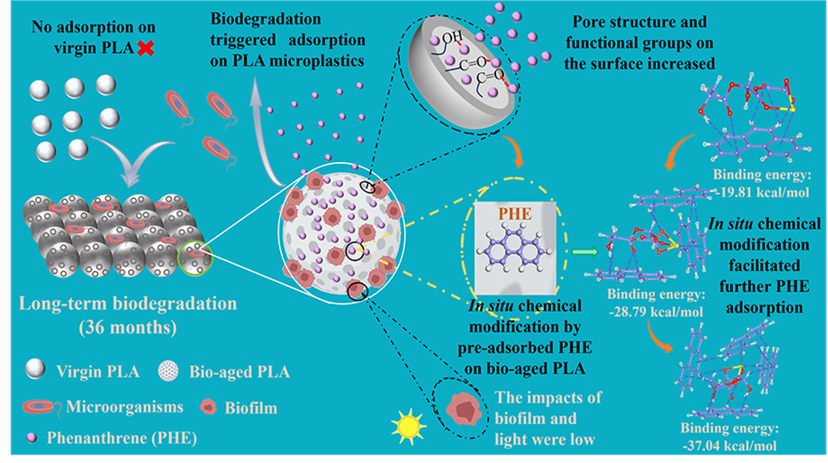
Figure 1. Schematic illustration for the adsorption mechanism of PHE on aged PLA microplastics The critical mechanisms were further elucidated via density functional theory (DFT) calculations and molecular dynamics (MD) simulations. Long-term marine biodegradation drastically increased the abundance of oxygen-containing functional groups (–C=O, –OH) on PLA surfaces and initiated preliminary adsorption of trace PHE. Pre-adsorbed PHE subsequently triggered in-situ surface rearrangement of PLA to construct supramolecular PLA-nPHE complexes, which facilitated successive PHE uptake and established a cyclic pathway of “degradation - adsorption - surface restructuring – re-adsorption”.
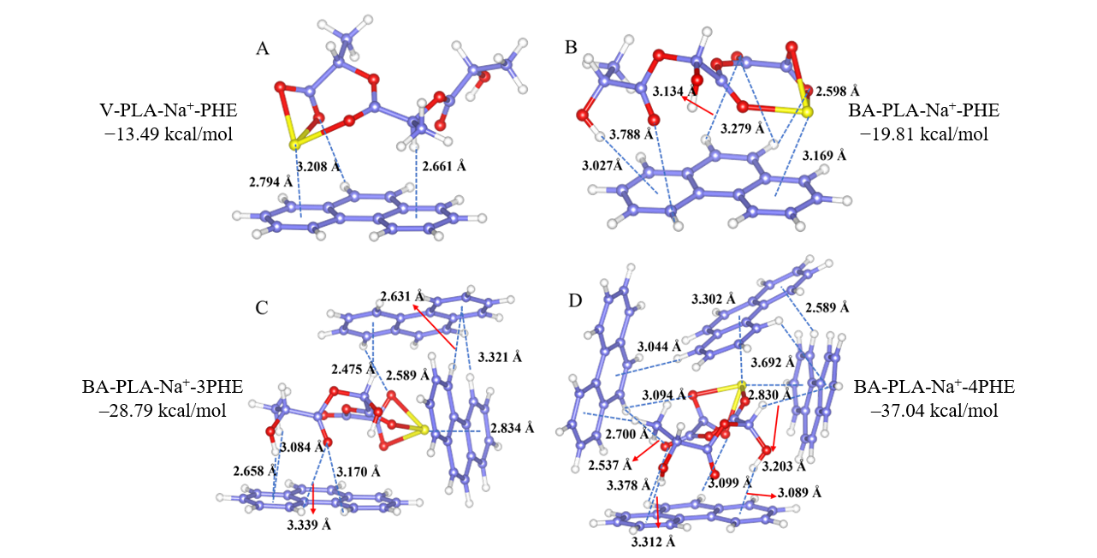
Figure 2. Results of DFT theoretical calculations These findings bridged the theoretical gap regarding pollutant adsorption and sequestration by solid matrices in marine environments. The research has been published in Environmental Science & Technology. Dr. Liu Xiaotao (postdoctoral researcher) and Feng Yuexia (PhD candidate) from Yantai Institute of Coastal Zone Research are the co-first authors, and Professor Lu Jian serves as the corresponding author. This work was jointly funded by the National Natural Science Foundation of China, the Taishan Scholars Program, and Global Ocean Negative Carbon Emissions (Global ONCE) Program. Research Information: Liu Xiaotao1, Feng Yuexia1, Lu Jian*, Wu Jun, Zhang Cui, Xiong Bitao.Biodegradation triggered the adsorption-desorption of phenanthrene on biodegradable polylactic acid microplastics in marine environment.Environmental Science & Technology, 2026, 60: 14161-14170. https://doi.org/10.1021/acs.est.6c01448.s001 |
| Appendix Download |
|
|
