| Research |
 |
Location:Home > Research > Research Progress |
| Yantai Institute of Coastal Zone Research Advances Understanding of Microbial Responses to Pulsed Disturbance and Monsoon-Driven Mixing in the Estuarine Ecosystem |
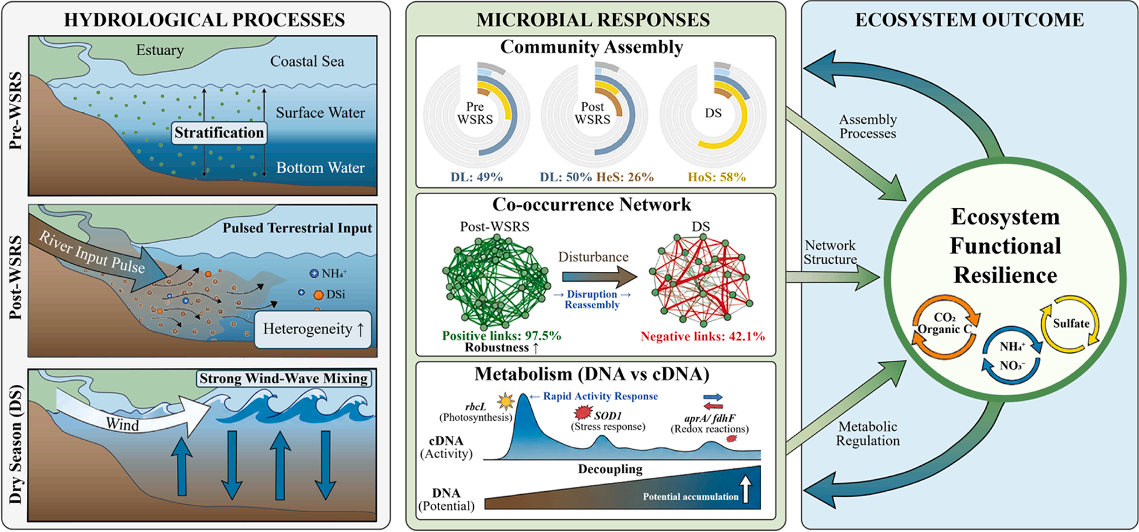
Recently, the research team led by Professor Song Qin from the Key Laboratory of Coastal Biology and Biological Resource Utilization, Yantai Institute of Coastal Zone Research, Chinese Academy of Sciences, made new progress in the study of microbial ecological response mechanisms in estuarine ecosystems. Focused on the coastal Yellow River Estuary as the study area, the team combined in situ observations with shipboard incubation experiments and revealed the stage-dependent response characteristics and ecological strategy succession pattern of microbial communities during water-sediment pulsed disturbance and subsequent monsoon-driven mixing (Fig. 1). The related findings were published in the international journal Water Research under the title “From pulsed disturbance to steady-state mixing: Succession of microbial ecological strategies in the estuarine ecosystem.”
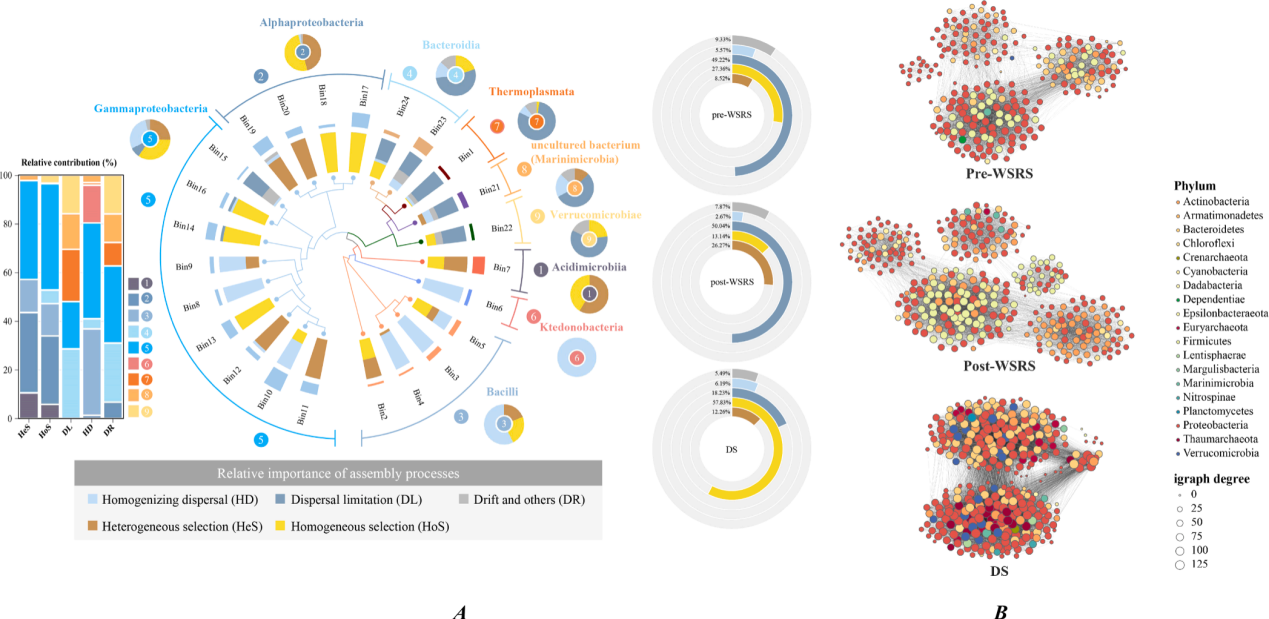
Fig. 1. Schematic diagram of microbial community responses in the coastal Yellow River Estuary under water-sediment regulation and monsoon-driven mixing. Estuaries are important ecological interfaces connecting land and ocean. They are affected by riverine input, sediment transport, monsoon-driven mixing, and human activities, and their hydrological environments show obvious dynamic changes. The Yellow River Estuary is a typical high-turbidity estuarine ecosystem. Since 2002, the Yellow River Water-Sediment Regulation Scheme (WSRS) has delivered large amounts of freshwater, sediment, and nutrients into the estuary and adjacent coastal waters every summer, forming strong pulsed disturbances. Subsequently, autumn and winter monsoon waves enhance water mixing, allowing riverine inputs and sediment resuspension to jointly influence the coastal estuarine environment and gradually drive it toward a relatively mixed state. To investigate how microorganisms respond to this hydrological transition from pulsed disturbance to monsoon-driven mixing, the research team integrated metagenomic sequencing, qPCR, and other techniques, together with community assembly analysis, microbial co-occurrence networks, and machine-learning interpretation models, to compare changes in microbial community assembly, co-occurrence networks, and metabolic functions across different hydrological stages in the coastal Yellow River Estuary. Meanwhile, the team conducted shipboard incubation experiments to simulate pulsed inputs during the water-sediment regulation process and to analyze microbial community responses over a short time scale, providing complementary evidence for the in situ observations. The results showed that microbial communities in the Yellow River Estuary may respond to anthropogenic pulsed disturbance and subsequent seasonal mixing through coordinated changes in community assembly processes, co-occurrence networks, and metabolic functions. After WSRS, pulsed inputs of suspended particles, nutrients, and organic substrates increased environmental heterogeneity and resource availability, forming heterogeneous and relatively resource-rich microenvironments. These environmental changes may have promoted the enhancement of heterogeneous selection in microbial community assembly, increased the synchronous occurrence of taxa with similar substrate-utilization capabilities or particle-associated habitat preferences, and formed a network structure dominated by positive associations and with relatively strong disturbance resistance (Fig. 2). At the same time, microbial functional gene pools related to carbon, nitrogen, and sulfur cycling also expanded.
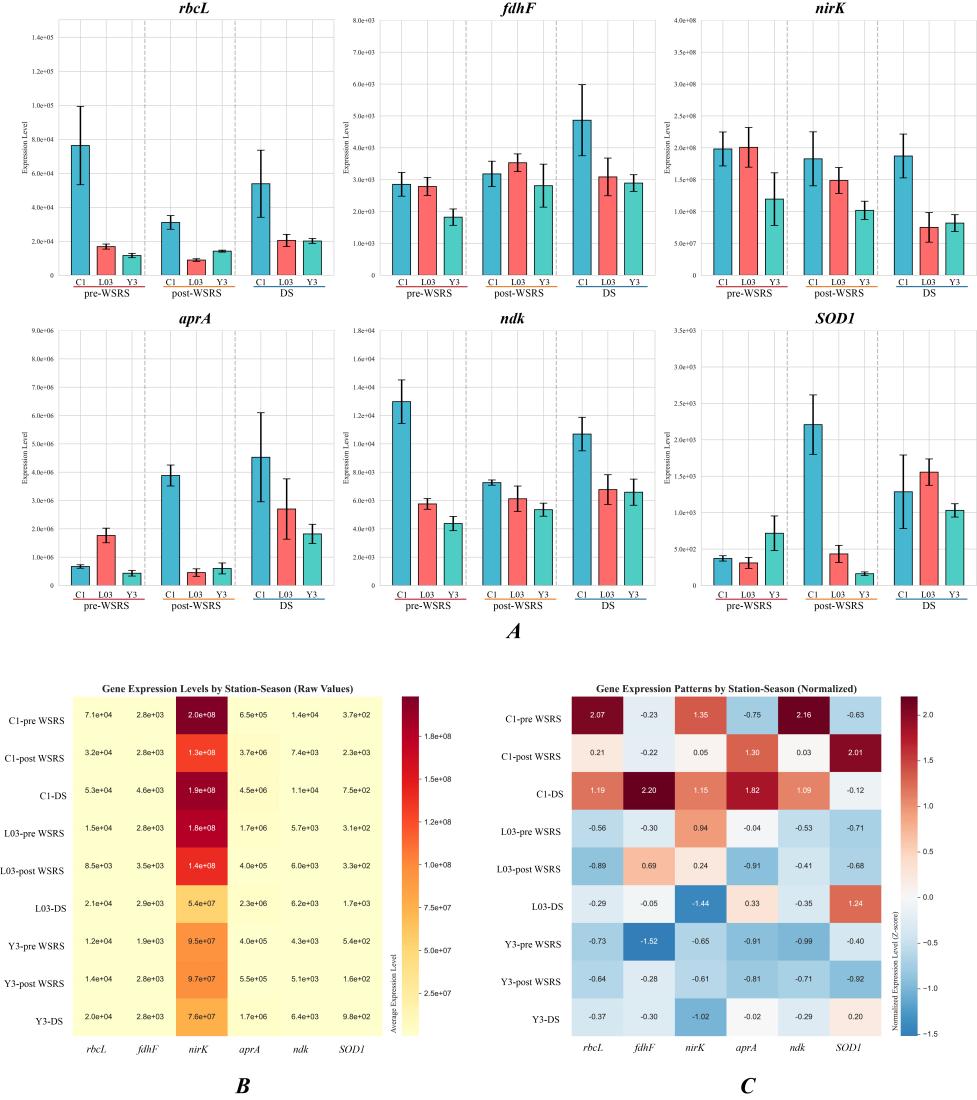
Fig. 2. Variations in microbial community assembly process and microbial co-occurrence network. In contrast, autumn and winter monsoon-driven mixing reduced hydrological heterogeneity and enhanced homogeneous selection in microbial community assembly, suggesting stronger directional filtering under more homogeneous environmental conditions. Under this background of environmental convergence and relatively constrained resources, niche overlap among microbial taxa may have increased, and the proportion of negative associations in the network also increased. At the same time, gene-specific DNA-cDNA decoupling indicated that microbial communities did not uniformly express their accumulated functional potential, but may instead selectively activate specific metabolic functions according to immediate environmental conditions (Fig. 3).
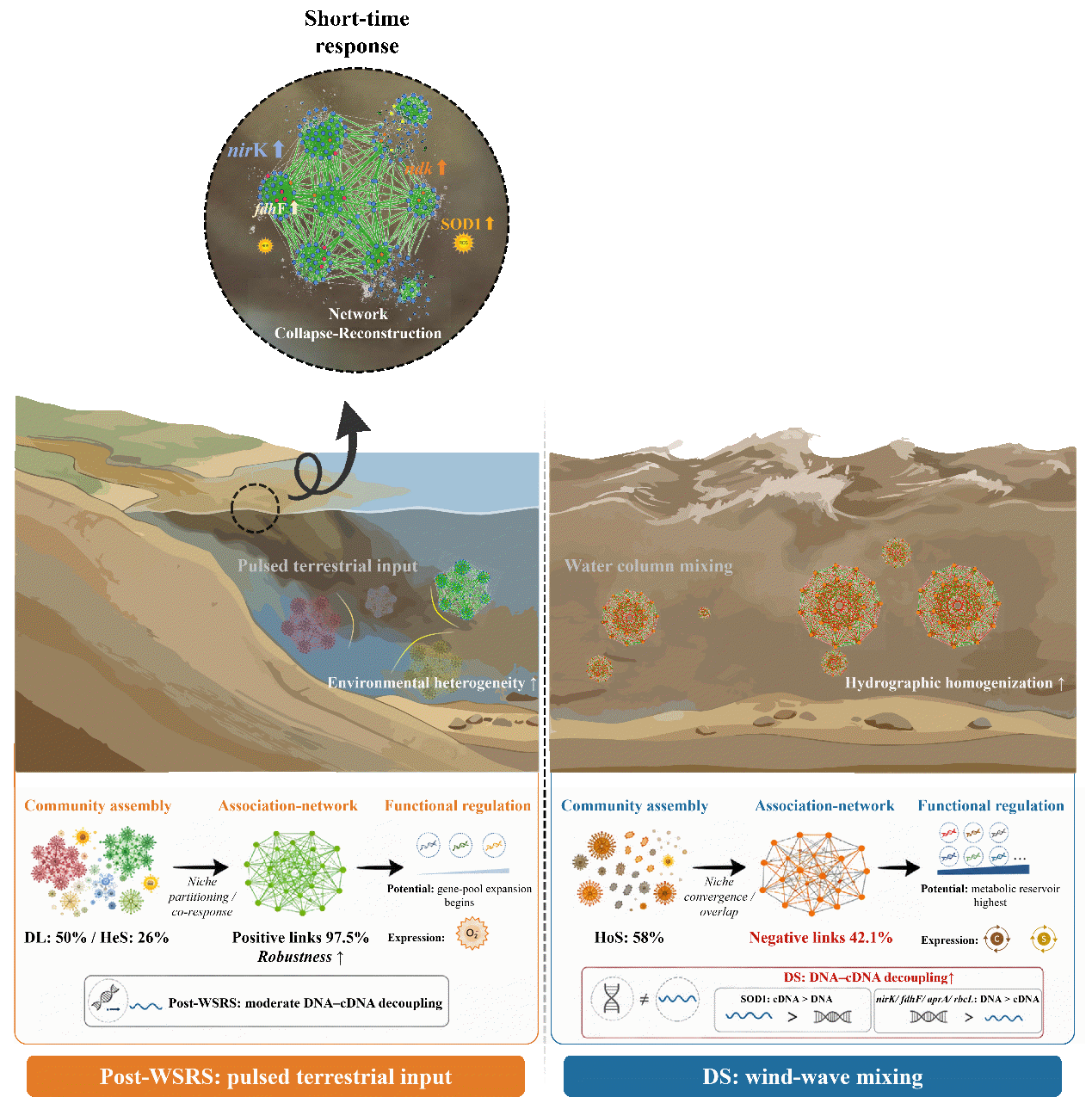
Fig. 3.In situ expression of key microbial functional genes quantified by cDNA-based qPCR across different periods. The shipboard incubation experiment further showed that acute pulsed inputs could alter microbial co-occurrence networks over a short time scale. In the treatment group, the edge number, graph density, and average degree of the network decreased markedly during the early stage of the experiment, followed by signs of network reorganization, suggesting that pulsed inputs may rapidly disturb existing association structures and initiate subsequent responses. Overall, this study suggests that microbial communities in the Yellow River Estuary undergo a stage-dependent ecological strategy succession. Community assembly, co-occurrence networks, and functional regulation respond in parallel to changes in hydrological conditions, resource availability, and mixing processes, which may help maintain microbial functional flexibility and biogeochemical stability in this dynamic estuarine system (Fig. 4). This study deepens our understanding of microbial ecological adaptation in estuarine coastal waters under large-scale water-sediment regulation and provides a scientific reference for assessing the potential impacts of anthropogenic hydrological regulation on coastal ecosystem functional stability.
Fig. 4. Mechanism diagram for ecological strategy succession in estuarine microbial communities following disturbance and mixing. Research Associate Ting Wang and master’s student Jinjie Ji are co-first authors, and Professor Jialin Li is the corresponding author of the paper. This work was supported by the National Key R&D Program of China, the National Natural Science Foundation of China, the China Postdoctoral Science Foundation, the Shandong Provincial Natural Science Foundation, the Science & Technology Fundamental Resources Investigation Program, and the seed project of Yantai Institute of Coastal Zone Research, Chinese Academy of Sciences. Publication information: Wang, T., Ji, J., Huang, Y., Li, J., Nadarajah, S., & Qin, S. (2026). From pulsed disturbance to steady-state mixing: Succession of microbial ecological strategies in the estuarine ecosystem. Water Research, 304, 126335. https://doi.org/10.1016/j.watres.2026.126335 |
| Appendix Download |
|
|
