| Research |
 |
Location:Home > Research > Research Progress |
| Yantai Institute of Coastal Zone Research Makes New Progress in Response Mechanism of Composite Extreme Wind Waves Induced by Typhoon and Cold Air in Temperate Semi-enclosed Seas |
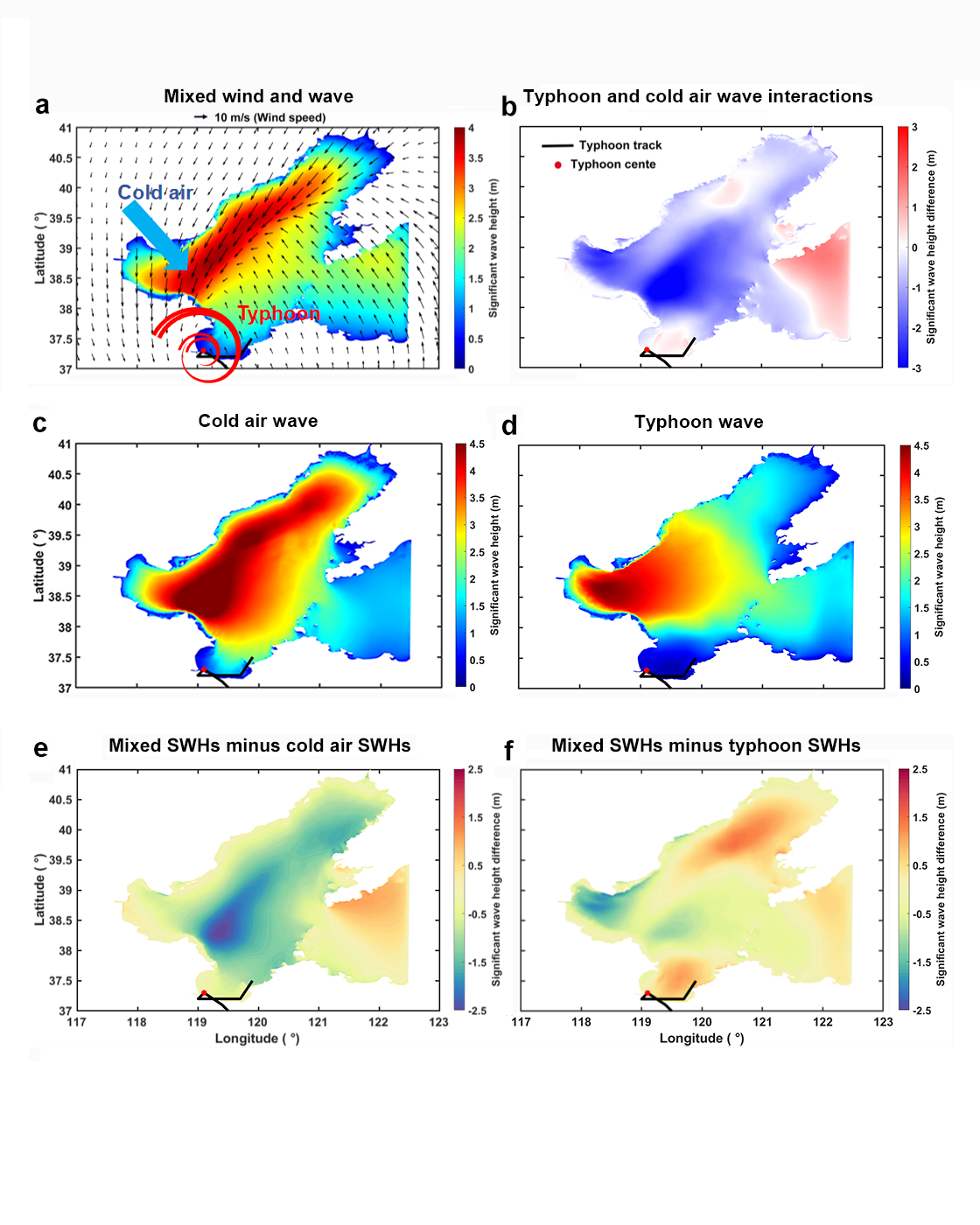
At the backdrop of global climate warming, the tracks of northwest Paacific typhoons have shifted markedly toward higher latitudes, with typhoon influence zones continuously expanding northward from tropical and subtropical waters to temperature sea areas. Composite strong wind fields frequently form when northward-moving typhoons overlap with southward cold air masses, posing brand-new threats to the safety of temperate coastal waters and coastal protection infrastructure in China. Existing research mostly focuses on wave processes driven by isolated typhoons or cold air masses, and the coupled response patterns and asymmetric driving mechanisms of sea waves under the joint action of the two weather systems remain unclear. To address this research gap, the Coastal Estuarine Physical Oceanography Research Group led by Miaohua Mao at the Yantai Institute of Coastal Zone Research, Chinese Academy of Sciences, carried out research on the evolution mechanism of extreme wind waves under the synergistic effects of typhoons and cold air masses in typical temperate semi-enclosed waters of the Bohai Sea. Relevant findings have been published in Journal of Geophysical Research: Oceans, a prestigious journal focusing on physical oceanography. Taking the composite extreme weather event of Typhoon Lekima passing through the Bohai Sea in 2019 alongside cold air as a typical case, the research team integrated wind field decoupling technology and refined numerical wave simulation. They quantitatively analyzed the differentiated driving effects of typhoon and cold air wind fields on wave characteristics and full-domain sea state evolution across the Bohai Sea, and accurately quantified the respective contribution ratios of the two systems to the wave field. Three core conclusions are drawn fron this study:
Figure 1: Spatial distribution of SWH in the Bohai Sea under independent typhoon, cold air, and the coupled forcing, as well as the relative contributions of the two wind fields to wave dynamics
Figure 2: Time series of wave spectra across multiple sub-regions of the Bohai Sea and disparities in sea state structures dominated separately by typhoons and cold air masses
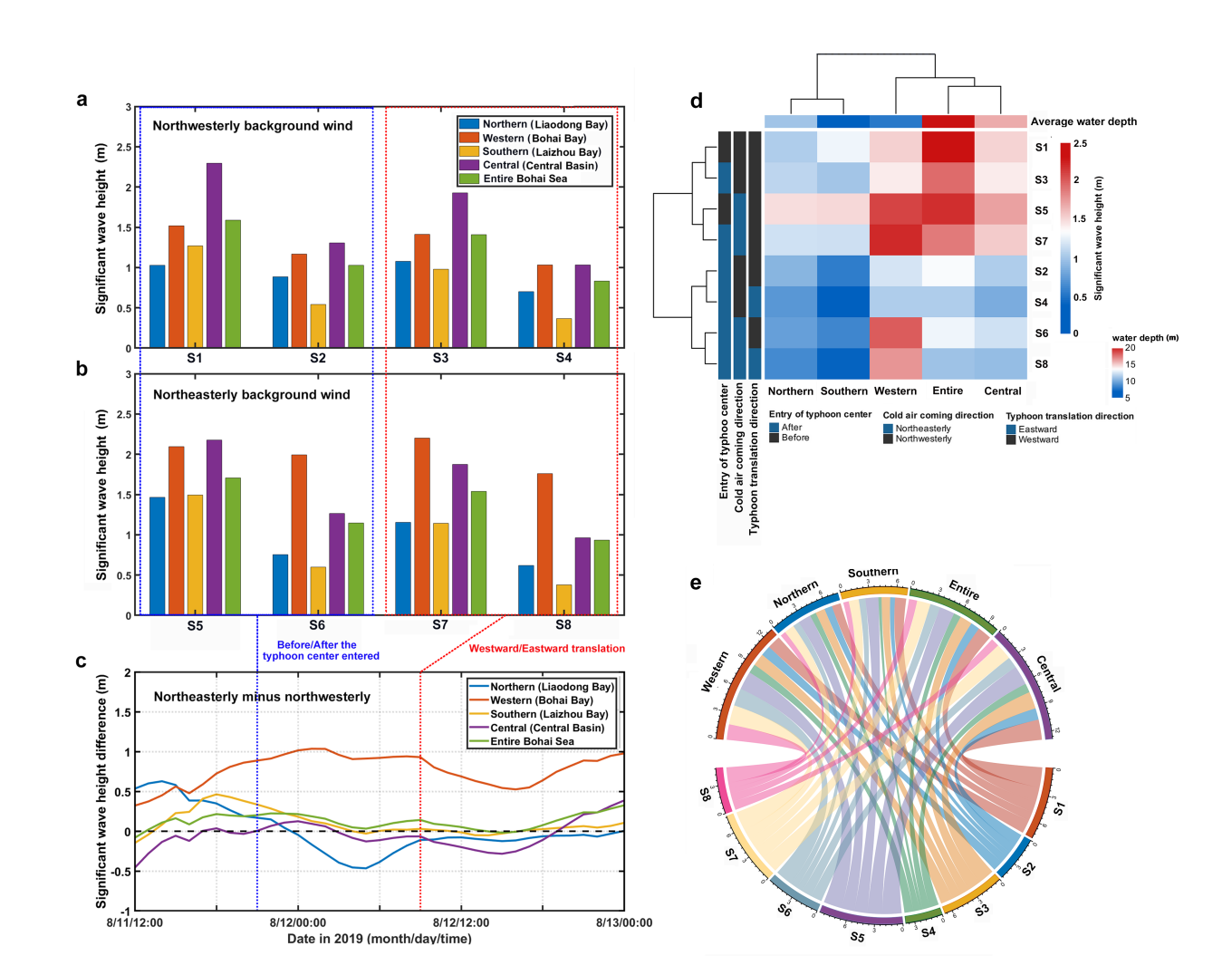
Figure 3: Controlling mechanisms and spatiotemporal clustering characteristics of spatial differentiation of wave heights across sub-regions under varying cold air inflow direction and typhoon tracks This research clarifies the fundamental differences in wave responses to composite wind fields between temperate semi-enclosed seas and open oceans. It improves the theoretical framework of coastal wave dynamics under the coupling of northward-moving subtropical typhoons and southward subpolar cold air masses, and fills the research gap regarding asymmetric forcing mechanisms of composite extreme ocean waves. The research outcomes can support marine disaster early warning, coastal engineering protection, and offshore operation risk management for composite strong wind events in temperate semi-enclosed seas. They effectively improve the forecast accuracy of extreme sea states in the Bohai Sea and similar shallow seas, and advance the construction of coastal disaster prevention and mitigation systems. The first author Jie Peng and the corresponding author Miaohua Mao are from the Yantai Institute of Coastal Zone Research, Chinese Academy of Sciences. This research was funded by the National Natural Science Foundation of China and supported by high performance computation platforms including the ORISE system of the Chinese Academy of Sciences. Relevant Paper References: Peng, J., Mao, M.*, and Du, J. (2026). Composite extreme wind‐wave event: Asymmetric forcing from typhoon and cold air in a temperate semienclosed sea. Journal of Geophysical Research: Oceans, 131, e2026JC024175. https://doi.org/10.1029/2026JC024175 Peng, J., Mao, M.*, and Xia, M. (2024). Wave Spectra Analysis on the Spatiotemporal Variability of Sea States under Distinct Typhoon Tracks in a Semienclosed Sea. Journal of Physical Oceanography, 54(3), 783-807. https://doi.org/10.1175/JPO-D-23-0066.1 Peng, J., Mao, M.*, and Xia, M. (2023). Dynamics of wave generation and dissipation processes during cold wave events in the Bohai Sea. Estuarine, Coastal and Shelf Science, 280, 108161. https://doi.org/10.1016/j.ecss.2022.108161 |

| Appendix Download |
|
|
