| Research |
 |
Location:Home > Research > Research Progress |
| Yantai Institute of Coastal Zone Research Achieves New Breakthrough in Medium- and Long-Term Intelligent Forecasting and Interpretability of Typhoon Storm Surge |
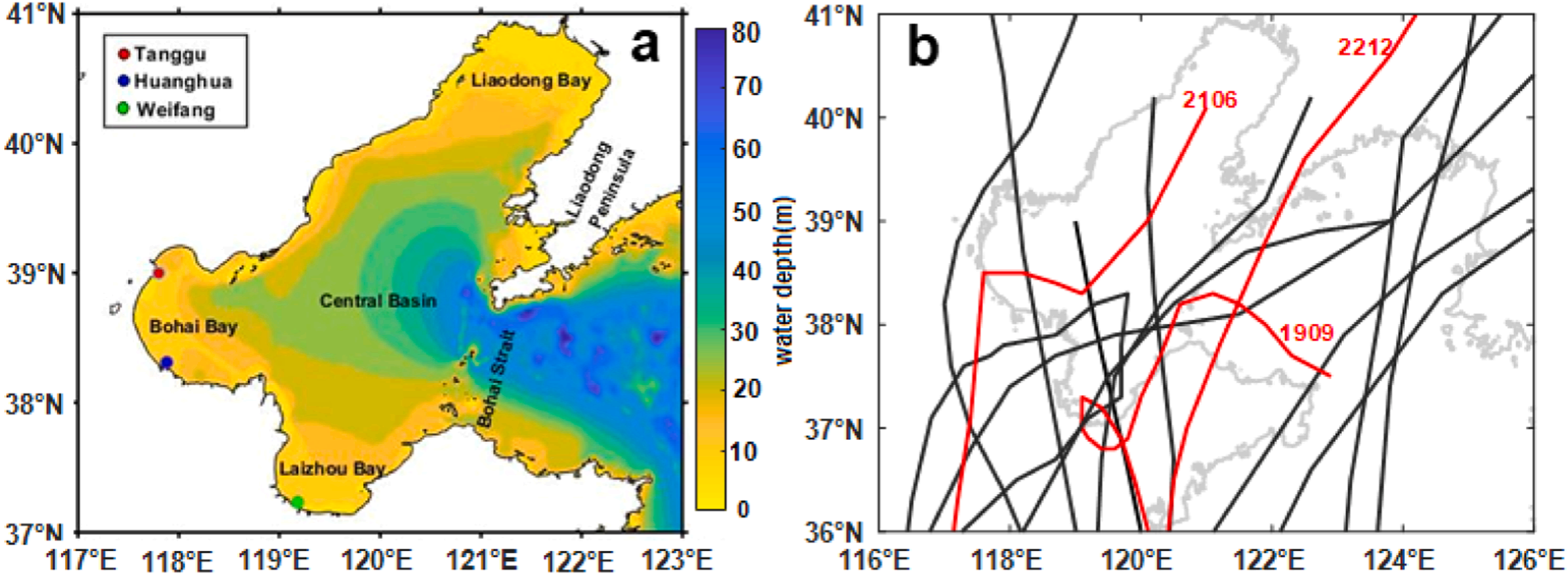
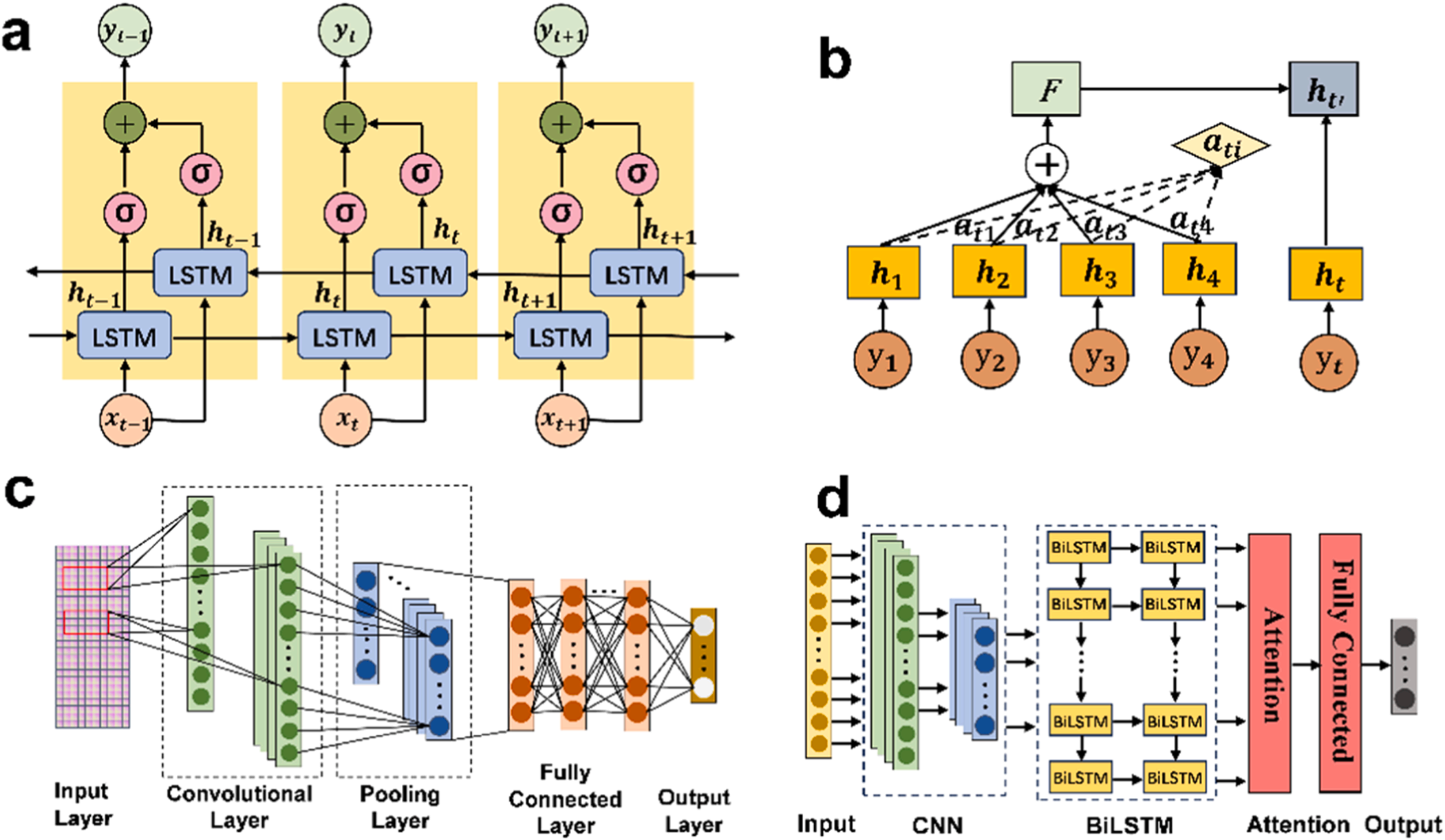
Storm surges represent extremely destructive marine disasters across coastal regions worldwide. Driven by accelerating global sea level rise, alongside marked increases in typhoon frequency and intensity, risks of storm surges, coastal flooding and sea water inundation along China’s coasts have been further exacerbated. The evolution of storm surges is governed by nonlinear coupling of multiple factors including typhoon tracks, atmospheric forcing, seabed topography and tidal dynamics, featuring strong nonlinearity and multi-scale spatiotemporal correlations. This complex nature has long constituted a major technical bottleneck restricting accurate long-term forecasting in marine disaster prevention and mitigation. To address this challenge, the Coastal Estuarine Physical Oceanography Research Group led by Miaohua Mao at the Yantai Institute of Coastal Zone Research, Chinese Academy of Sciences, collaborated with the University of Maryland, USA. The joint team developed a novel storm surge forecasting system integrating hybrid deep learning architectures and multi-dimensional interpretability analysis. This system delivers high-precision medium- and long-term storm surge forecasting for the Bohai Sea and quantitatively clarifies the core physical driving mechanisms governing storm surge evolution. The research marks aa pivotal technical breakthrough in intelligent marine disaster forecasting, delivering robust technical support for coastal storm surge risk management, emergency early warning and disaster prevention and mitigation. Focusing on the typical Bohai Sea waters, the team selected three core tide gauge station at Tanggu, Huanghua, and Weifang as key research sites (Figure 1). Based on field observation data from 15 typhoons impacting the Bohai Sea between 2000 and 2022, combined with the ADCIRC numerical simulation technique, the researchers constructed a high-precision, highly reliable dataset for model training. Targeting technical obstacles associated with different forecast lead times of storm surges, the team built a differentiated intelligent forecasting model system. For 24-hour multi-step continuous forecasting: A CNN-BiLSTM-Attention hybrid deep learning model was constructed (Figure 2). Convolutional Neural Networks (CNN) extract local marine environmental features, Bidirectional Long Short-Term Memory (BiLSTM) networks capture temporal evolution patterns, and an attention mechanism adaptively weights critical forecasting information, forcing an end-to-end frame work for accurate 24-hour continuous prediction. For 24–72-hour medium- and long-term single-step forecasting: A standalone BiLSTM model was adopted. This design effectively mitigates error accumulation stemming from complex model architectures and substantially improves stability and reliability for medium- and long-range forecasts. To resolve the “black box” limitation of deep learning models and clarify model prediction logic and physical mechanisms, the team integrated three mainstream interpretability analysis tools including SHAP, PIM, and SFS. The framework quantifies the influence weight of various meteorological and oceanic factors on storm surge prediction outcomes from multi-dimensional and multi-level perspectives, enabling physical interpretability and traceable processes for intelligent forecasting results.
Figure 1 Study Area and Typhoon Tracks
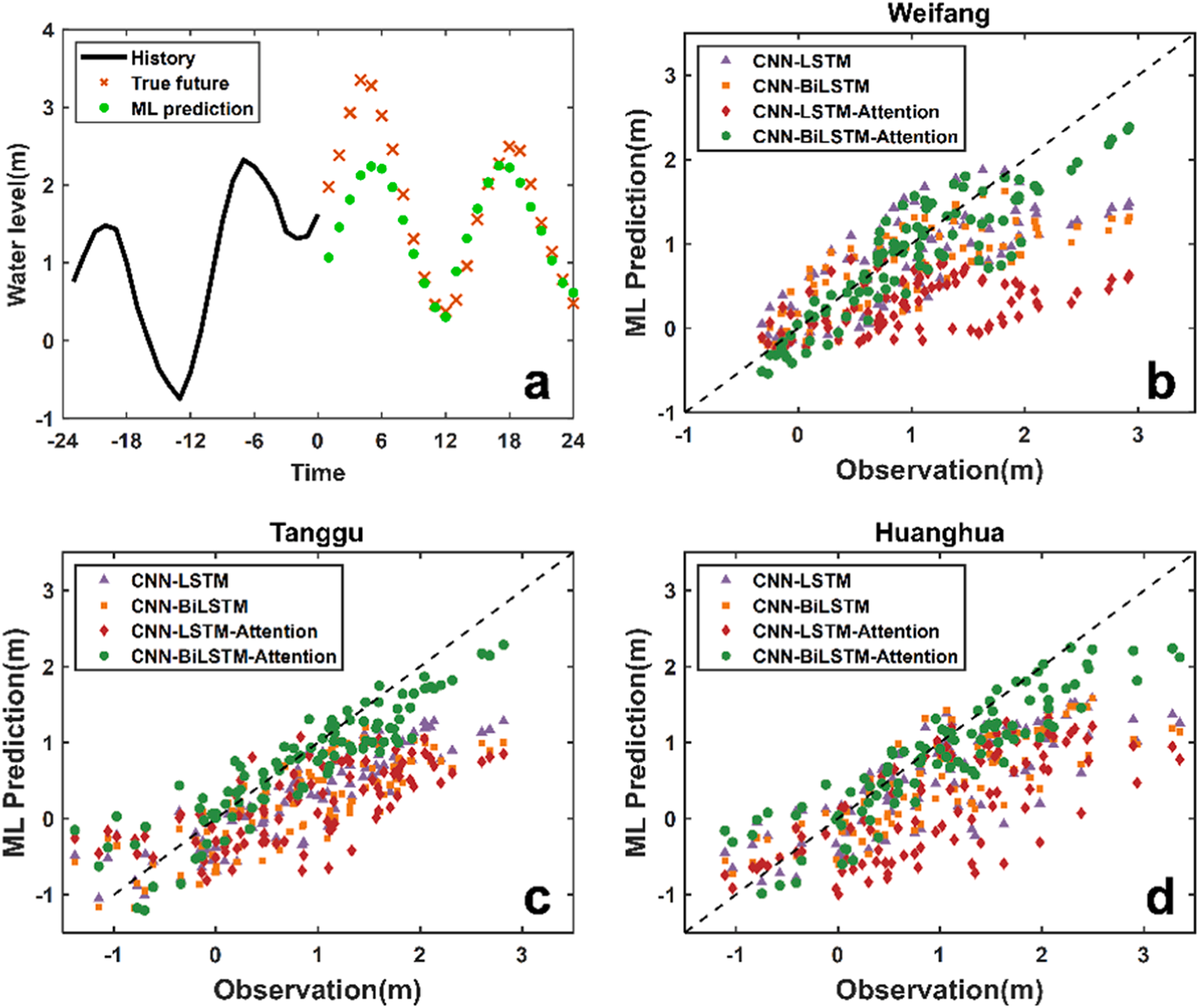
Figure 2 Architecture of the Hybrid Machine Learning Method Model performance validation tests were conducted using three independent representative typhoon events including Muifa, Infa and Lekima. Results demonstrate that the CNN-BiLSTM-Attention model embedded with the attention mechanism delivers for lower errors for 24-hour multi-step forecasting compared with traditional benchmark models (Figure 3). The standalone BiLSTM model exhibits high precision and strong robustness for 24–72-hour medium- and long-range forecasting. Within a 48-hour window, prediction biases for both peak storm surge magnitude and peak occurrence time fall within acceptable thresholds for operational applications. This fully aligns with the emergency early warning timeline for disaster prevention and mitigation along the Bohai coast, granting the model strong practical value for operational deployment.
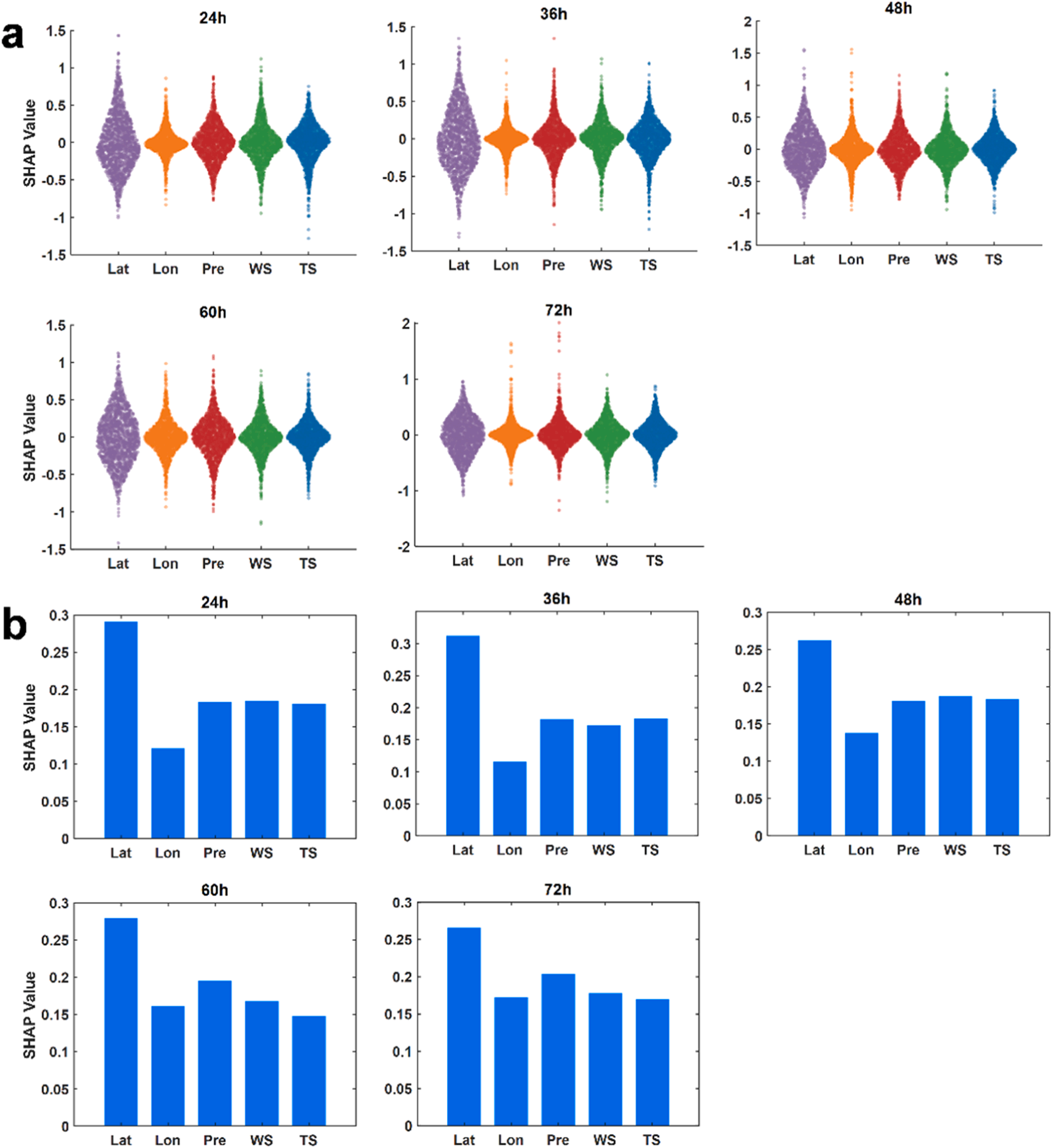
Figure 3 Scatterplots Comparing 24 Hour Multi-Step Forecasts and Observations Multi-dimensional interpretability analysis further reveals core physical driving patterns behind Bohai Sea storm surge evolution (Figure 4). Results from the three analytical methods show high consistency, verifying that typhoon latitude acts as the dominant predictive factor across all forecast lead times, followed by typhoon central pressure and maximum wind speed as the second and third most influential factors. This strongly confirms the dominant role of atmospheric forcing in storm surge generation and evolution. The research also identifies regular variations in factor influence weights across different forecast horizons. For 24-48 hours medium-range forecasts: Storm surge evolution is synergistically driven by multiple factors including typhoon latitude, central pressure, maximum wind speed and translational speed. For 60-72 long-range forecasts: The influence weight of typhoon central pressure rises markedly. Via the inverse barometer effect, it modulates low-frequency background water levels across the sea, emerging as the most stable and critical predictive signal for long-lead storm surge forecasting. Additionally, this study finds that atmospheric forcing contributes relatively less to storm surges at the Tanggu station within the Haihe River Estuary. This indicates that storm surge forecasting in estuarine zones with compound flood hazards requires further incorporation of river runoff and tidal phase as key factors, pointing out clear directions for subsequent model optimization.
Figure 4 SHAP Analysis of Feature Importance for Different Forecast Lead Times The research findings titled“Explainable deep learning methods for medium- and long-term storm surge forecast”, were published in the prestigious journal Ocean Modelling. This work received funding support from the National Science Foundation of China, Chinese Academy of Sciences, and the Key R&D Program of Shandong Province. Relevant Paper References: Su C., Sahoo B., Mao M.*, Xia M., 2026. Explainable deep learning methods for medium- and long-term storm surge forecast. Ocean Modelling, 204, 102789. Su C., Mao M.*, 2026. Probabilistic Storm Surge Forecasting in the Bohai Sea: A Deep Learning Framework with Adaptive Uncertainty Quantification. Estuarine, Coastal and Shelf Science, 336, 109877. Su C., Sahoo, B.*, Mao, M., Xia, M., 2025. Machine Learning Techniques for Predicting Typhoon-Induced Storm Surge Using a Hybrid Wind Field. Journal of Geophysical Research: Machine Learning and Computation, 2, e2024JH000507. |
| Appendix Download |
|
|
