Wetlands are essential carbon (C) reservoirs, crucial for climate change mitigation, but their hydrological regimes are increasingly threatened by climate change. Inundation depth, a key hydrological factor in wetlands, influences soil organic carbon (SOC) storage and stability, yet its effects on SOC fractions and stability, especially in subsoils, remain critically underexplored.
To bridge these knowledge gaps, the Coastal Wetland Evolution Mechanism and Ecological Restoration Research Group (research team of Guangxuan Han) at the Yantai Institute of Coastal Zone Research, Chinese Academy of Sciences, conducted a six-year continuous inundation depth control experiment at the Yellow River Delta Coastal Wetland Ecological Experimental Station of the Chinese Academy of Sciences. Six water level gradients of 0, 5, 10, 20, 30, and 40 cm were established to systematically analyze the changes and regulatory mechanisms of organic carbon composition in surface soil (0–20 cm) and deep soil (20–40 cm). The results elucidate the vertical regulation mechanism of inundation depth on wetland SOC stability, providing theoretical support for predicting wetland C cycle feedback under the background of global change. Simultaneously, it provides quantitative scientific evidence for hydrological regulation and C sink management in coastal wetland ecological restoration.
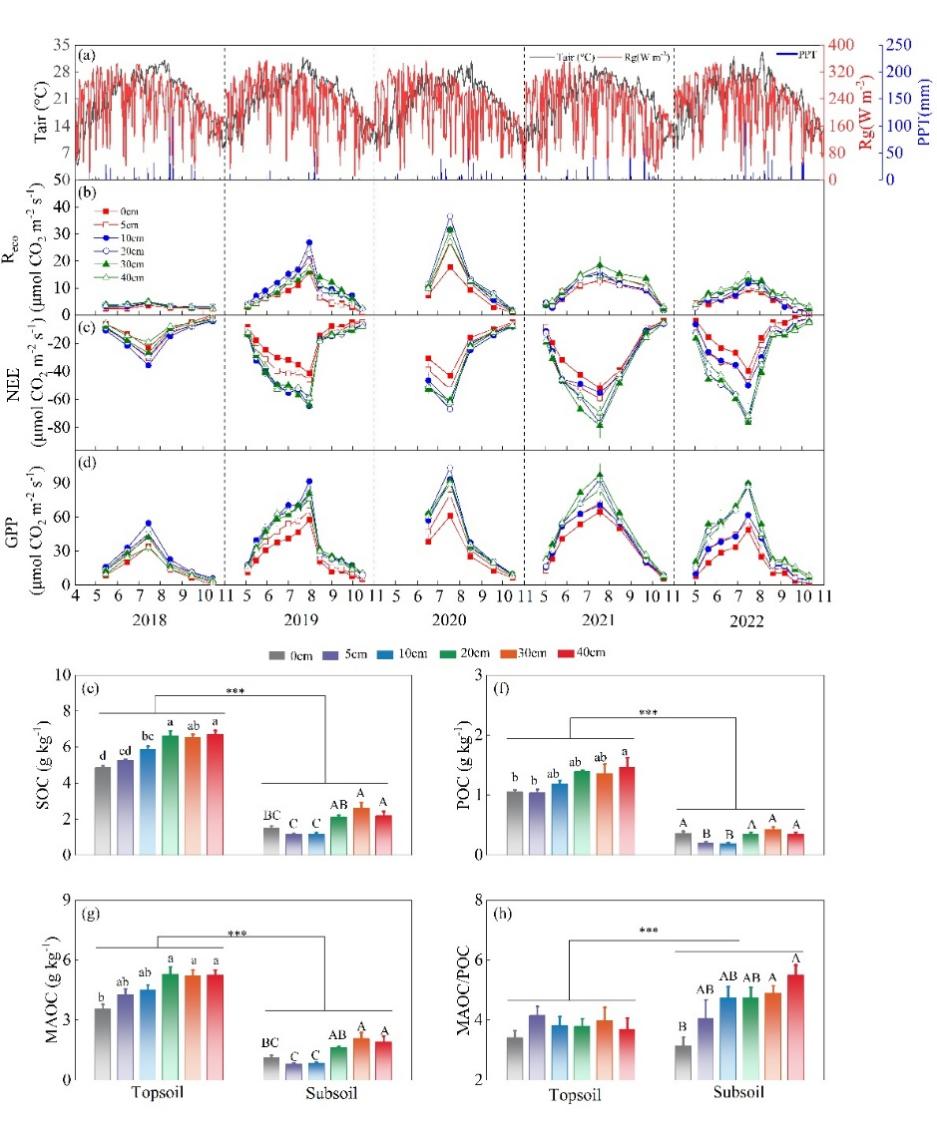
Figure 1. Variations in soil organic carbon (SOC), particulate organic carbon (POC), mineral-associated organic carbon (MAOC) and MAOC/POC ratio at the topsoil and subsoil under different inundation depths. Different letters on the top of error bars demonstrate significant differences among inundation depths (p < 0.05). **p < 0.01; ***p < 0.001.
As the inundation depth increased from 0 cm to 40 cm, SOC content increased significantly by 62% in the topsoil and by 222% in the subsoil (Figure 1). Particulate organic C (POC) and mineral-associated organic C (MAOC) responded differently across soil layers, with topsoil POC driven by plant inputs and MAOC by microbial turnover, while subsoil POC and MAOC were influenced by nutrient availability and mineral protection, respectively. Inundation depth increased the subsoil SOC stability but did not affect topsoil stability, where key mineral protection capacity (i.e., clay and free/amorphous Fe/Al oxides) remained unaltered. In the subsoil, both microbial biomass and mineral protection jointly enhanced SOC stability (Figure 2).
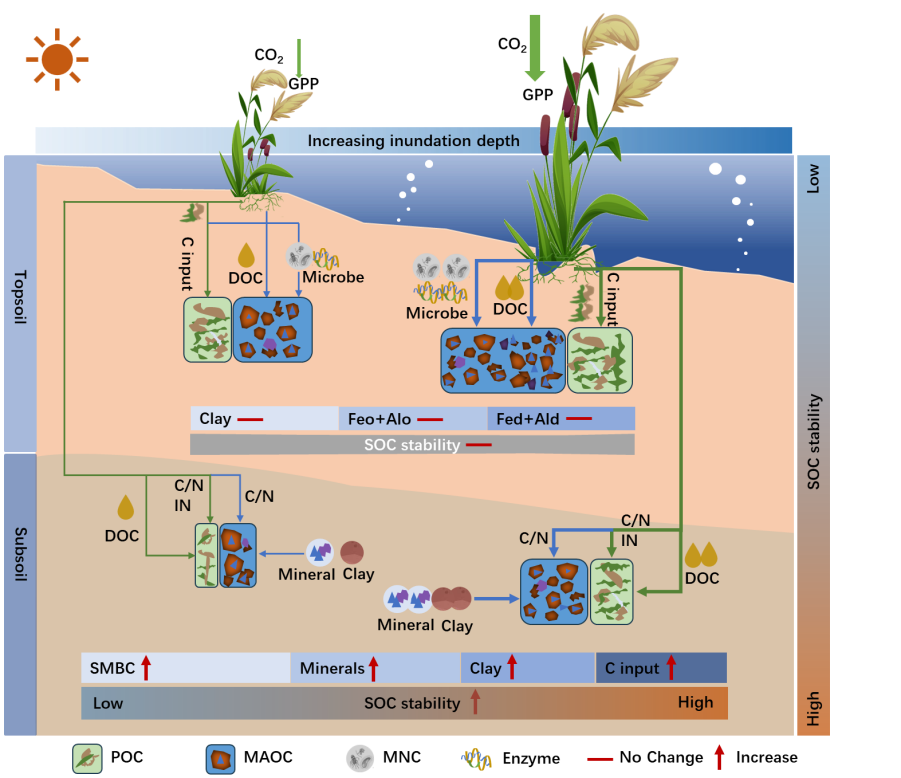
Figure 2. A schematic diagram illustrates the effect of inundation depth on SOC fraction and MAOC/POC ration in a wetland
We also identified 20 cm inundation depth as an operational benchmark where SOC accumulation reaches a saturation plateau (Figure 1). This suggests that, within hydrologically managed restoration settings in the Yellow River Delta, maintaining moderate inundation around this depth may help maximize SOC storage, whereas deeper inundation did not provide additional SOC gains. Collectively, these findings advance our mechanistic understanding of depth-dependent carbon dynamics and provide a practical reference for site-level hydrological regulation, although the applicability of this threshold to other wetlands requires further validation.
The relevant findings, titled "Inundation depth modulates wetland soil organic carbon stability by altering microbial biomass and mineral protection," were published in the international soil science journal Geoderma. This research was supported by projects such as the National Key Research and Development Program of China and the National Natural Science Foundation of China.
Paper information:
Zhao, M.L., Wang, L.J., Xiao, L.L., Ma, T., Li, Y., Paytan, A., Lichtfouse, E., Song, W.M., Wang, X.J., Chu, X.J., Zhang, X.S., Wei, S.Y., Han, G.X.* 2026. Inundation depth modulates wetland soil organic carbon stability by altering microbial biomass and mineral protection. Geoderma, 469, 117798. https://doi.org/10.1016/j.geoderma.2026.117798

