| Research |
 |
Location:Home > Research > Research Progress |
| Research Progress on Wave Breaking and Morphodynamic Responses at the Yellow River Estuary by Yantai Institute of Coastal Zone Research, CAS |
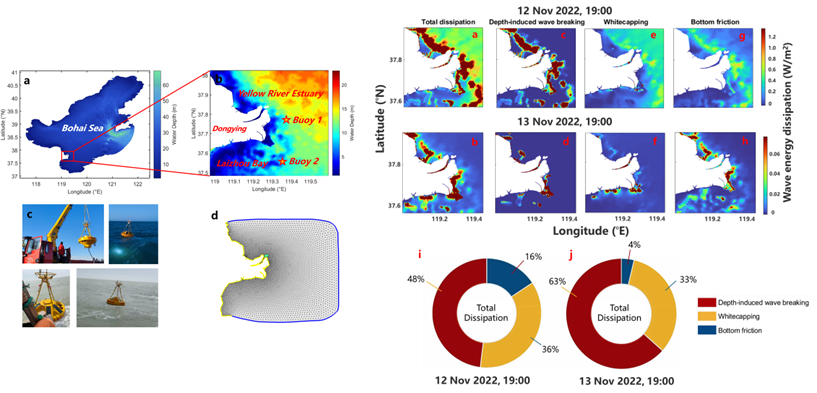
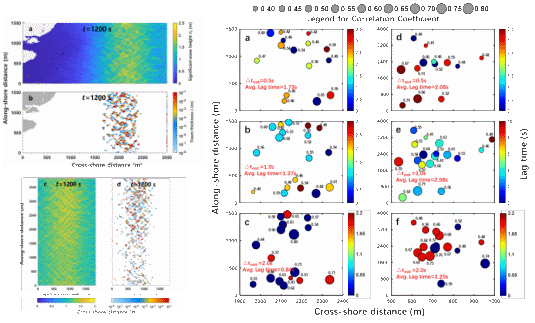
Waves constitute the core dynamic factor driving coastal geomorphic evolution, and their propagation and deformation processes are jointly modulated by nearshore bathymetry and coastal configuration. As the most critical hydrodynamic evolution process within the surf zone, wave breaking directly determines the trend of coastal geomorphic evolution. In conventional ocean numerical simulations, wave breaking is frequently simplified as a spatially uniform energy dissipation source term, whereby the physical disparities among diverse breaking modes including plunging, surging and spilling breakers are neglected. In fact, distinct wave breaking types correspond to drastically different turbulence structures, momentum transfer mechanisms and near‑bed forcing effects, which profoundly control sediment incipient motion and geomorphic patterns within the surf zone. Nevertheless, how the spatial differentiation of wave breaking types establishes intrinsic links between external wave To address the abovementioned research bottleneck, the Nearshore‑Estuarine Physical Oceanography Research Group (led by Prof. Miaohua Mao) from the Yantai Institute of Coastal Zone Research, Chinese Academy of Sciences, in collaboration with Ludong University, carried out systematic numerical simulation and dynamic‑mechanism analysis targeting typical estuarine coastal segments of the Yellow River Delta. Taking a moderate‑intensity cold air event in November 2022 as a representative case, the research team constructed a one‑way coupled numerical simulation system integrating SWAN‑FUNWAVE‑TVD‑XBeach. Driven by ERA5 re‑analysis wind fields from the European Centre for Medium‑Range Weather Forecasts, the third‑generation wave model SWAN supplies wave spectrum boundary conditions for the phase‑resolving wave model FUNWAVE‑TVD, which is further coupled with the sediment geomorphology module XBeach. This workflow fully reproduces the causal evolutionary chain spanning wave‑breaking onset to morphodynamic responses. Three core conclusions are drawn from this study: First, depth‑induced breaking acts as the primary mode of wave energy dissipation in the nearshore Yellow River Estuary (Figure 1). A kilometer‑scale high wave‑energy dissipation zone parallel to the shoreline forms off the Yellow River Estuary, serving as the key hydrodynamic forcing boundary driving subsequent geomorphic processes. Wave energy dissipation exhibits prominent north‑south spatial heterogeneity. The temporal lag effects of wave height and foam thickness are markedly more pronounced in the southern sector than its northern counterpart (Figure 2).
Figure 1. Study domain (left) and the relative contribution of wave energy dissipations in the Yellow River Estuary
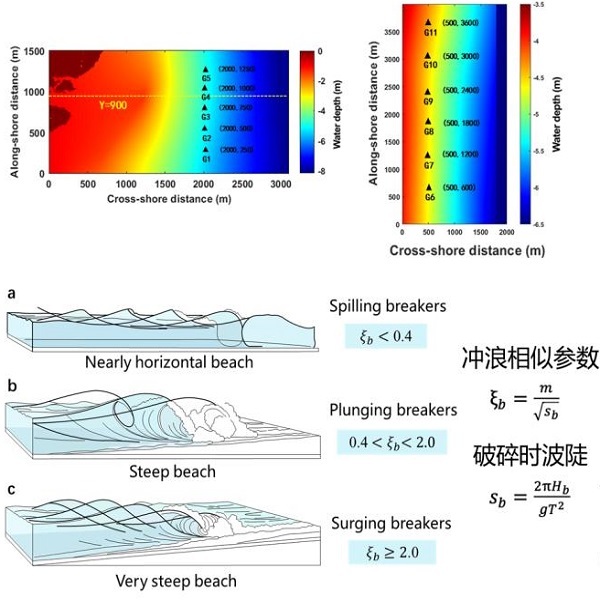
Figure 2. The significant wave height, foam thickness and lag relationship in the southern and northern sectors of the Yellow River Estuary Second, notable differentiation exists in wave breaking mechanisms between northern and southern coastal sectors of the Yellow River Estuary (Figure 3). The northern estuary is dominated by surging breakers accounting for 56 %, followed by spilling breakers at 44 %. By contrast, spilling breakers prevail absolutely in the southern estuary with a proportion of 79 %, reaching a local maximum of 91 %. Mechanism analyses reveal that such spatial‑differentiation patterns are jointly governed by beach‑slope gradient and incident wave steepness.
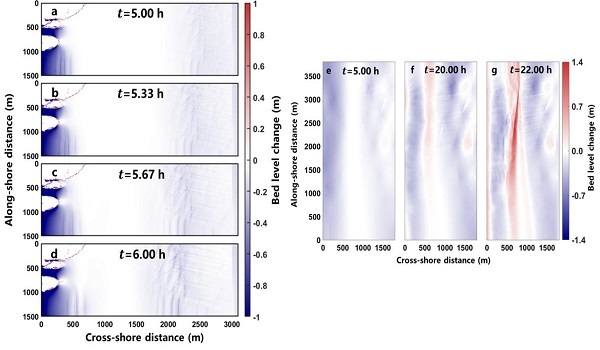
Figure 3. The wave breaking types in the southern and northern sectors of the Yellow River Estuary Third, distinct wave breaking types shape differentiated geomorphic response patterns (Figure 4). Surging breakers can trigger intense local jets and offshore return flows, fostering a rhythmic, erosion‑dominated bar‑trough geomorphic system along the northern shore. Spilling breakers, by comparison, generate diffused and homogeneous flow‑field structures, producing relatively gentle bed configurations favorable to sediment deposition in the southern coastal sector.
Figure 4. Bed level changes in the southern and northern sectors of the Yellow River Estuary This research clarifies the spatial differentiation features of wave breaking types and the intrinsic mechanisms of near‑shore morphodynamic responses in the Yellow River Estuary. It improves the complete causal‑chain theoretical framework of “wave breaking mechanics‑geomorphic evolution”, and fills the research gap regarding geomorphic effects of wave‑breaking processes under high‑energy wave environments of the Yellow River Estuary. The research outcomes provide scientific support for coastal‑erosion mitigation, shoreline‑stability assessment and coastal ecological restoration engineering for the Yellow River Delta. The relevant finding entitled ‘Wave breaking characteristics and short‑term morphodynamic responses under energetic wave conditions in the Yellow River Estuary’ published in Ocean Engineering, a top‑tier international authoritative journal in ocean engineering. Mengyuan Han, a doctoral candidate at Yantai Institute of Coastal Zone Research, is the first author, and Prof. Miaohua Mao serves as the corresponding author. This work was funded by the National Natural Science Foundation of China, the Chinese Academy of Sciences and research projects of Yantai City. Numerical simulations were performed on the ORISE supercomputing platform of the Chinese Academy of Sciences. Bibliographic Information Han, M., Mao, M.*, Peng, J., and Zhu, J. (2026). Wave breaking characteristics and short-term morphodynamic responses under energetic wave conditions in the Yellow River Estuary. Ocean Engineering, 128062. Gao, S., Mao, M.*, and Xia, M. (2025). Wave dynamics in the Yellow River Estuary during cold wave and typhoon events. Ocean Modelling, 102568. Nguyen, Q. T., Mao, M.*, and Xia, M. (2023). Numerical Modeling of Nearshore Wave Transformation and Breaking Processes in the Yellow River Delta with FUNWAVE-TVD Wave Model. Journal of Marine Science and Engineering, 11(7), 1380. |
| Appendix Download |
|
|
