| Research |
 |
Location:Home > Research > Research Progress |
| Yantai Institute of Coastal Zone Research Makes New Breakthrough in Matching Intelligent Storm Surge Forecasting Model Complexity to Data Characteristics |
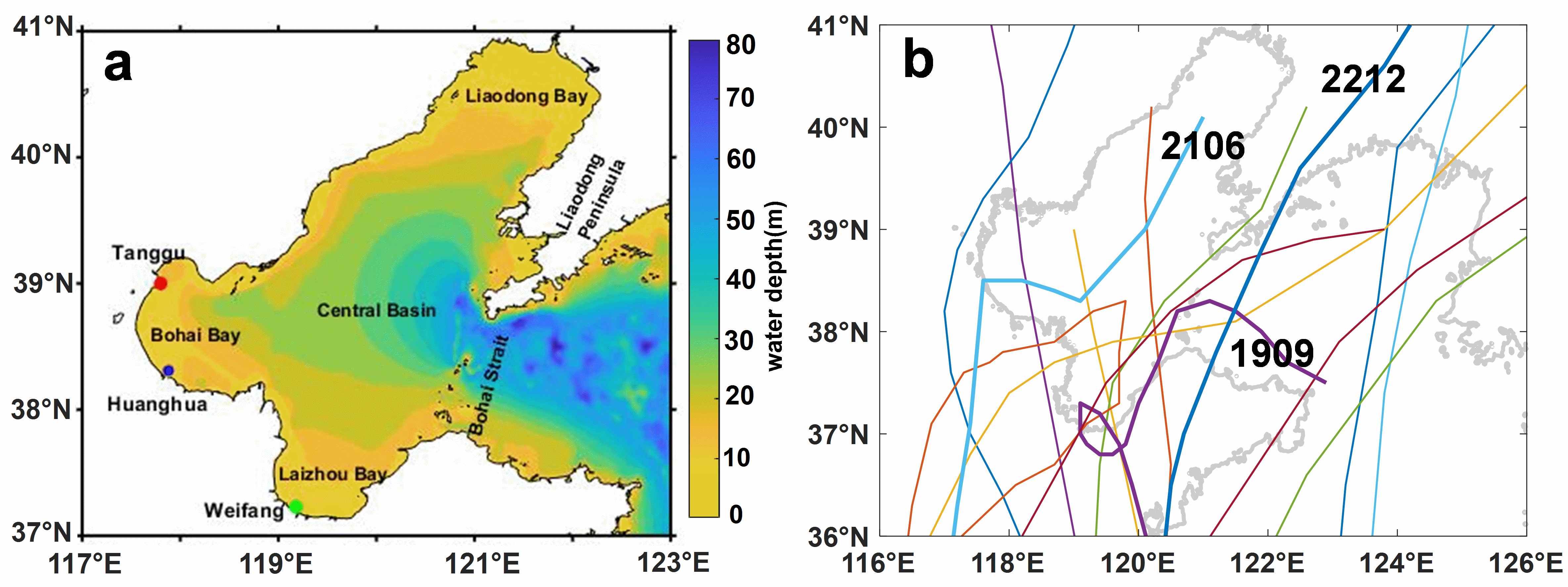
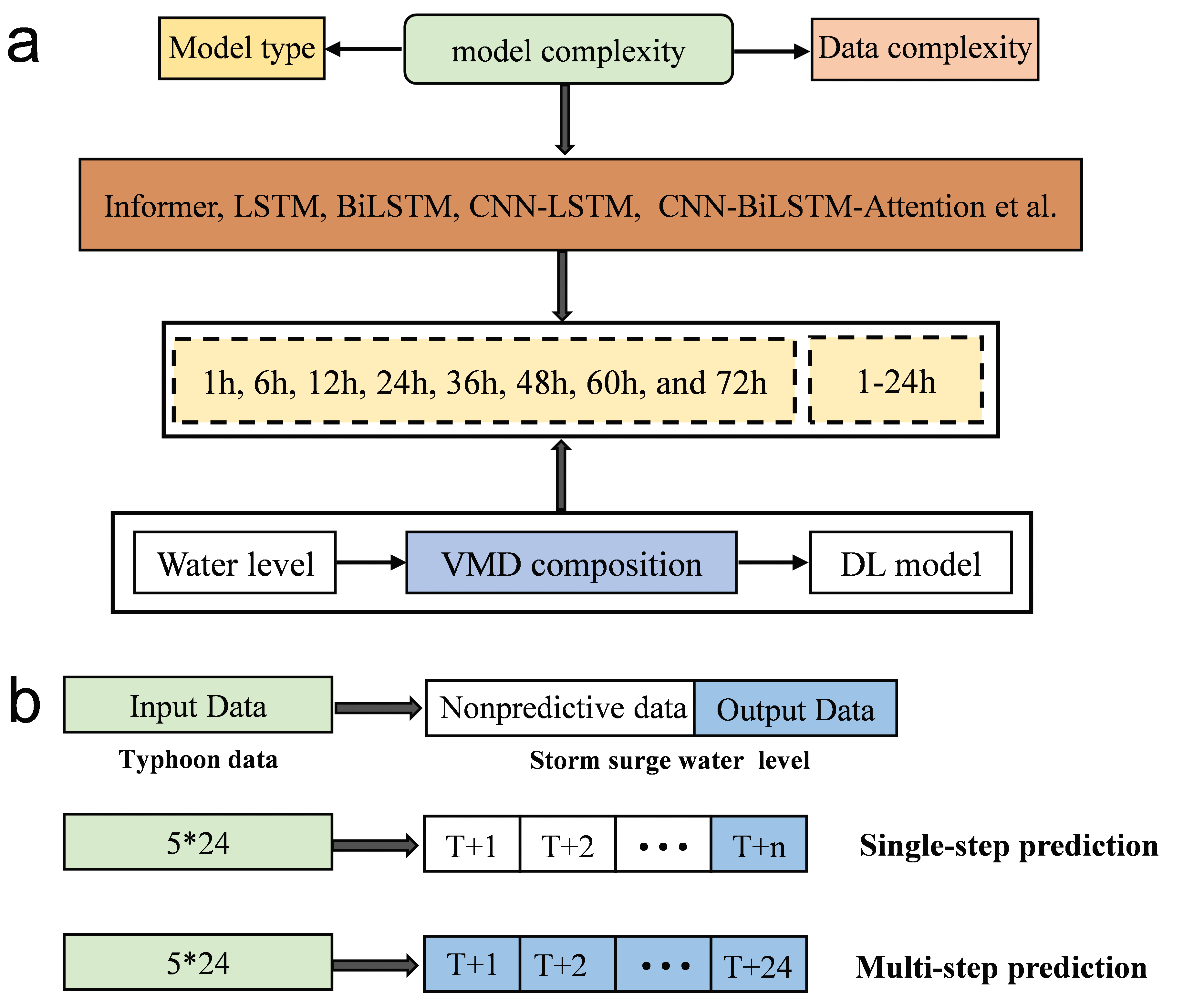
Storm surges are among the most destructive marine hazards worldwide. Their generation, evolution and decay are governed by the nonlinear coupling of multiple factors, including typhoon tracks, atmospheric forcing, seabed topography and tidal processes. Deep learning has become an important technical means for storm surge forecasting, yet existing research practice shows that forecasting skill does not improve linearly with model structural complexity. In the Bohai Sea, for example, typhoon observations are limited; blindly stacking complex models not only fails to improve forecast accuracy but also leads to overfitting, degraded generalization and enormous computational cost. To address this bottleneck, the Coastal and Estuarine Physical Oceanography Research Group (led by Prof. Miaohua Mao) at the Yantai Institute of Coastal Zone Research, Chinese Academy of Sciences, together with the University of Maryland Eastern Shore, conducted a systematic study on how the match between deep-learning model complexity and data characteristics affects storm surge forecasting. From two dimensions, network architecture and data characteristics, the study clarified the nonlinear relationship between model complexity and forecast accuracy, providing a theoretical basis for the selection and design of intelligent marine hazard forecasting models. The study selected three tide gauge stations, Tanggu, Huanghua and Weifang, as study sites (Fig. 1). Based on measured observations from 15 typhoons affecting the Bohai Sea during 2000-2022, the team comprehensively evaluated nine deep-learning models of progressively increasing complexity across forecast lead times of 1, 6, 12, 24, 36, 48, 60 and 72 h (Fig. 2). Variational mode decomposition (VMD) was introduced to reduce the complexity of the time-series data, and particle swarm optimization (PSO) was used to automatically tune model hyperparameters. Conventional machine-learning methods, including linear regression, multilayer perceptron, support vector regression, random forest and XGBoost, were included as benchmarks; a leave-one-event-out validation strategy was adopted, and three independent typhoon cases were used to test model performance.
Fig. 1 Study area and typhoon tracks
Fig. 2 Schematic of the input-output structure of the deep-learning models Results show that in single-step forecasting, the relatively simple recurrent networks LSTM and BiLSTM achieve the best balance between accuracy and complexity, with root-mean-square errors below 0.32 m and correlation coefficients above 0.94. Adding convolutional or attention modules to the network did not systematically improve forecast accuracy under the sample conditions of this study, but significantly increased computational cost (Fig. 3). Notably, under small-sample, low-dimensional input conditions, ensemble learning models such as random forest showed strong competitiveness, with forecasting performance at some stations even slightly better than that of deep-learning models, confirming the core understanding that model complexity should be matched to data complexity.
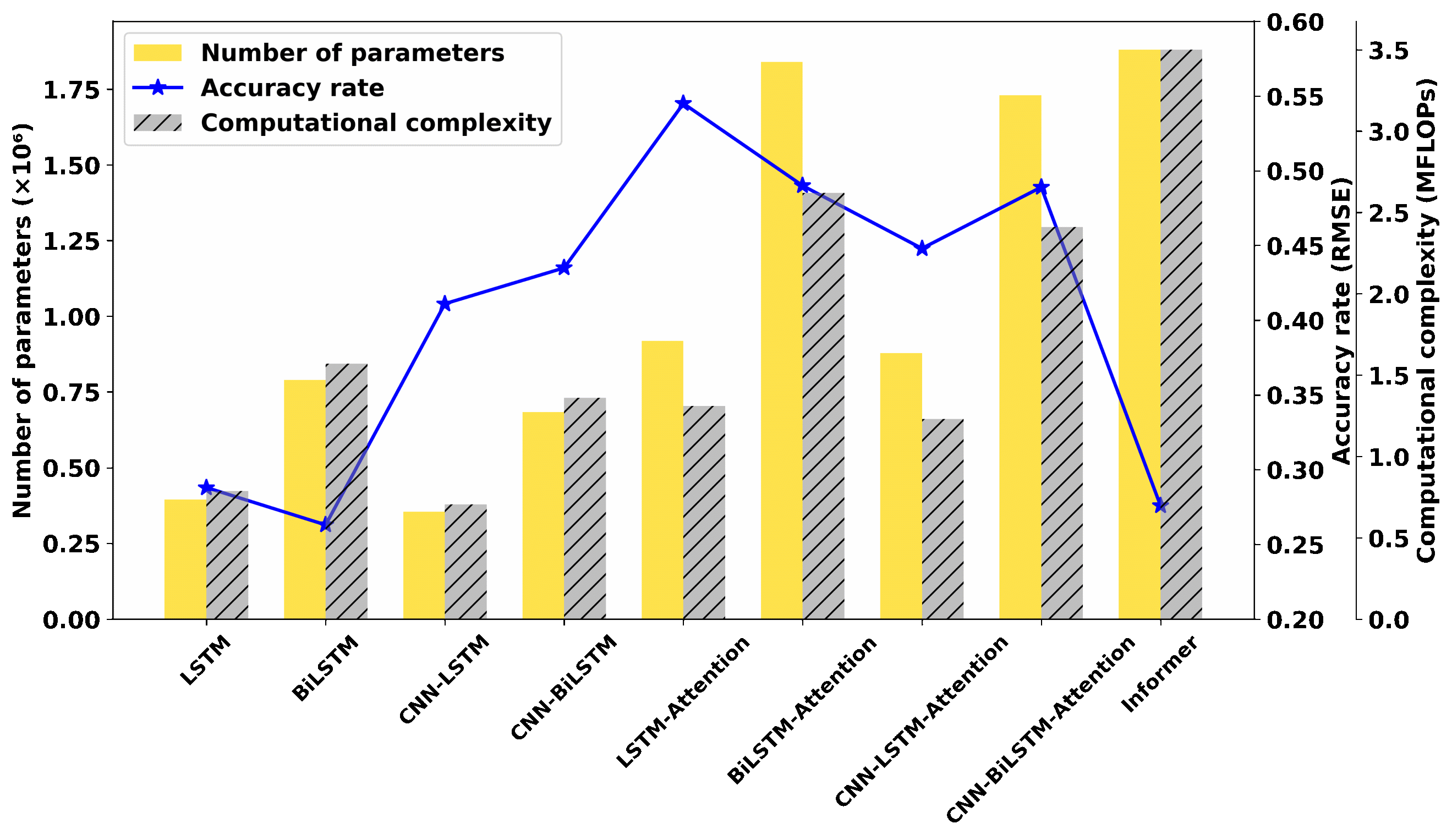
Fig. 3 Comparison of single-step forecast errors of the models at different lead times After VMD-based time-series decomposition, the overall forecast accuracy of composite models such as VMD-LSTM improved, but the reconstruction of extreme storm surge peaks remained unstable. For multi-step forecasting tasks, the advantages of complex models such as CNN-BiLSTM-Attention and Informer came into play. The Informer model performed best overall in terms of both average accuracy and peak simulation capability, with errors in the timing of storm surge peaks mostly within 1 h; at long lead times, the optimization effect of VMD decomposition was also more stable. Further analysis revealed a nonlinear relationship between model complexity and forecast accuracy. Moderately increasing model complexity can improve forecast performance, but beyond a critical threshold the gains decay markedly and performance may even decline (Fig. 4). On this basis, the team proposed a task-adaptive model selection strategy for operational applications, recommending that operational early-warning systems give priority to model schemes that satisfy causal constraints, thereby providing technical support for storm surge emergency warning and marine disaster prevention and mitigation in China's coastal zones.
Fig. 4 Comparison of parameter count, computational cost and forecast accuracy of deep-learning models for storm surge forecasting The results were published under the title “Optimizing storm surge forecasting in the Bohai Sea by matching deep learning model complexity to data characteristics” in Acta Oceanologica Sinica, a T1 journal in China's high-quality sci-tech journal ranking. The work was supported by the National Natural Science Foundation of China, the Chinese Academy of Sciences and the Key Research and Development Program of Shandong Province. Related paper: Su, C., Mao, M.*, Sahoo, B., 2026. Optimizing storm surge forecasting in the Bohai Sea by matching deep learning model complexity to data characteristics. Acta Oceanologica Sinica, 45(9), 1–17. |
| Appendix Download |
|
|
